Sunday, October 25, 2015

Connecting William Trautman of Berks County to his son Peter Trautman of Somerset County PA, DAR style!

Somerset County, Pennsylvania.

I've written a lot about Peter Trautman, also spelled Troutman, who is one of my DAR ancestors, meaning that he served in the Revolutionary War. Now I want to connect him to his father William Trautman.

When I started doing genealogy back about 10 years ago, my personal proof standard was haphazard at best. If I saw it in a tree of someone I knew and trusted, or if Mom had found her proof, then it was good enough for me! Access to records back when Mom started doing genealogy in the early 1970s, was difficult to come by. Luckily, she lived in the geographic center of the locations of most all of our ancestors so if she took a day trip, she could find a lot of documents. When I look at her notes now, much of what I find on Ancestry using the general search function was already found by her. She collected binders full of census records form the early 1790 census to about 1880 for the counties circling our primary locations of interest. She was a non-stop collector of records! She even had at home rolls of microfilm and a reader!!

I've mentioned before about her correspondences with fellow genealogists across the country. She'd evaluate their skills and then share what she could and received whatever they had. It was a slow painstaking process helped along by the message boards. And once she had vetted the correspondent, she used what they sent.

Now, we work off of original records and I'm busy updating the Big Tree she built out over the decades with the best records I can find. It's a slow process but it will be worth it.

I mention all of this because I see this history of The Way We Worked in the DAR Ancestor records. Applications from the earliest time - about 1900 - contain little data and you're lucky to get names and dates. The applications, which are all available on the DAR website at DAR.org under Genealogy along with much else, from the middle of the 20th Century have names, dates, and places and sources. If you are applying today one of the tasks will be to make sure that your application brings with it the most updated information possible. And we're all held to rigorous standards.

So, now on to the Trautman father and son. At some point "proving" my lineal connection to Peter Trautman I realized that his father Wilhelm or William Trautman was also listed as a DAR patriot! But... they were not connected, and in other words, no one who descended from Peter had also made a supplemental or additional application proving their lineal descent from William! Whoopie! I could do that!

So off I went, knowing that I'd already proven my descent from Peter, and set out to prove Peter's connection to William as his son. Sounded easy enough.

So what sort of documents might prove that connection? What would you look for? How about a birth record, or a church baptismal record? That would work, wouldn't it? Hmmm. Peter was born in Berks County, PA, and that was already in the DAR records for him, so I checked FamilySearch Wiki to see what they said about birth or baptism records there. Nothing panned out there or anywhere else I looked, and believe me, I looked. Next stop: what other records would prove a father-son connection?

How about will and probate records? Yup! I have William's will and it names Peter as his oldest son. Got that from FamilySearch. It was written in English and German and probated in February 1790. I even have a transcription from a Trautman cousin years ago, so I wouldn't have to transcribe the whole thing for the DAR application, but would have to check that transcription for accuracy. Easy enough.

But I wasn't going to submit that will alone! I also needed to prove that my Peter Trautman was indeed the one and only Peter Trautman who was born in Berks County and moved to Bedford County that later became Somerset County. How was I going to do that?

I checked all the census and tax rolls for both counties for a William Trautman and a Peter Trautman. The point of this is to prove that there was only one William Trautman and only one Peter Trautman in that location at that time. There is also a William Trautman Jr., son of William Sr. and he's mentioned in the will too as one of the administrators, so that's confusing. Here's what I found, below, and as you can see, while it provided some useful bits that could fill out a timeline, it's not conclusive when it comes to proving a father-son relationship. William Sr. died in berks Co. in 1790.


Census: Year/ County

Peter Trautman

William Trautman

1768 Proprietary Return for the County of Berks for the year 1768


Listed as carpenter. This is William Sr. because Jr was born in 1763. No other William Trautman listed.

1783 PA Supply Tax, Bedford Co PA

no

no

1788 tax and exoneration for Londonderry, Bedford Co

Yes

no

US 1790, Bedford, Berks.

no

no

US 1790, any PA

no

no

1793 Tax Assessment, Bedford Co

yes

yes

Pennsylvania, U.S. Direct Tax Lists, 1798

Londonderry, Bedford Co


Londonderry, Bedford Co

US 1800


Londonderry, Somerset, Pennsylvania

none

PA Septennial Census 1800

Londonderry, Somerset, Pennsylvania

Londonderry, Somerset, Pennsylvania

US 1810

Southampton, Somerset, Pennsylvania

Southampton, Somerset, Pennsylvania

Next, I double-checked Peter's military file on Fold3 and his pension application. There was a nice note from his brother William Jr. vouching for him. William lived in Somerset County. So there was a useful location there. And Peter's pension file stated numerously that he served from Berks County, and that would substantiate the Berks / Somerset connection. But where was the father, William Sr.? Not there. Keep looking.
I've found that land records can be a girl genealogists best friend, and they were here too, but I wasn't too optimistic at first. You see Peter received land in Somerset County through the process of Bounty Land for service in the Revolutionary War from the state of Pennsylvania, so he probably didn't get any land from his father as the first son. And in looking at the chart above, you can see that Peter was in Bedford Co. in 1788. But I thought of land records anyway.
I retraced my steps through the DAR records and applications for William Sr. and Peter. I asked for help in a Facebook group devoted to helping other members work up their lineage. An angel came forward and said that there was reference to a deed in Deed Book 11, Berks County, that named Peter Trautman and also mentioned William Sr. as his father!! Oh joy!
Yes, and there it was. Just as promised. I had already searched the Berks County Recorder's Office online and not found any results for Trautman or Troutman, but it was there just the same. Probably operator error.
It's a beautiful thing, that deed! In it Peter sells his interest in his father's estate. It names as his father as William Trautman of Greenwich Township, Berks County. And it also stated that the grantor is Peter Trautman of Bedford County, later Somerset County. To my eyes, it's a beautiful document!
So there is was. I had the will and I had the deed. I also had the DAR listing for both William Trautman and Peter Trautman, and the dates and places line up perfectly! A triangulation: three documents that prove the same conclusion.
Next step, filling out the paperwork to prove my lineage from myself to William Trautman born in Germany and died in Berks County, PA, who is a DAR patriot because he took the Oath of Allegiance in 1788. Good man.
 
Deed

Will
 
 
The URL for this post is:

Thursday, October 22, 2015

The Troutman Land in Southampton Twp., Bedford, then Somerset Co., PA


After we came back from our drive to see Comps Church, I took a browse through the Troutman files on the computer. Found this, below. It shows that Benjamin Franklin Troutman, son of Peter Troutman who fought in the Revolutionary War and is buried there in the cemetery, donated the land that the church is built on, and the very land in which he's buried. Take a look. I've underlined the relevant parts, but you might have to click on the pages images in order to read them.


Now, I do love a good timeline and I've been working on one for Benjamin Franklin Troutman (1780- 1856) and his father Peter Troutman (1754-1846). Then to give it a whole other layer of frosting, added Peter's own father, William, born in 1730 in Germany and landed in Berks County  where he died in 1790. There an amazing number of documents that filled out that timeline pretty well. When put together it tells the saga of a family's pull west powered by a desire for good and then better farming land.

Peter had already moved from Berks County PA to his Bounty Land Grant in Somerset County which is more westerly in Pennsylvania, by the time his father William passed in 1790. Both Peter and his brother William were mentioned in old William's will. William was appointed as Administrator with his brother John. Peter had already moved to the Southampton area when his father made the will. As the oldest son, Peter might have been named as Administrator and I'd wondered why he wasn't. Did they have a falling out, was Peter deemed untrustworthy by his father? But then I put together the timeline and could see the answer right before my eyes. Peter couldn't have been named Administrator because he had already moved away to Bedford County.


The will of William Troutman Sr. is interesting and was worthwhile looking for. It names his sons, Peter and William Jr., so that's valuable right there. But the probate file had two copies of his will, one in English and one in German. Look there above and see a page from each version. What this told me is that they were still very German and probably spoke it at home and in their close circle of friends.

Just after William died, his son William Jr. moved to Somerset County and lived near his brother Peter. Because he was named as one of the administrators, he needed to renounce so that he could move. I have no documentation that this is the official reason why he renounced but it seems logical. Look.

William Jr., Peter his brother, and Peter's son Benjamin are all buried in Comps Cemetery on land that Benjamin donated to the church. At least I think that's William next to Peter there. Some say it's Peter's son who died early but the stone for William is in pieces now.

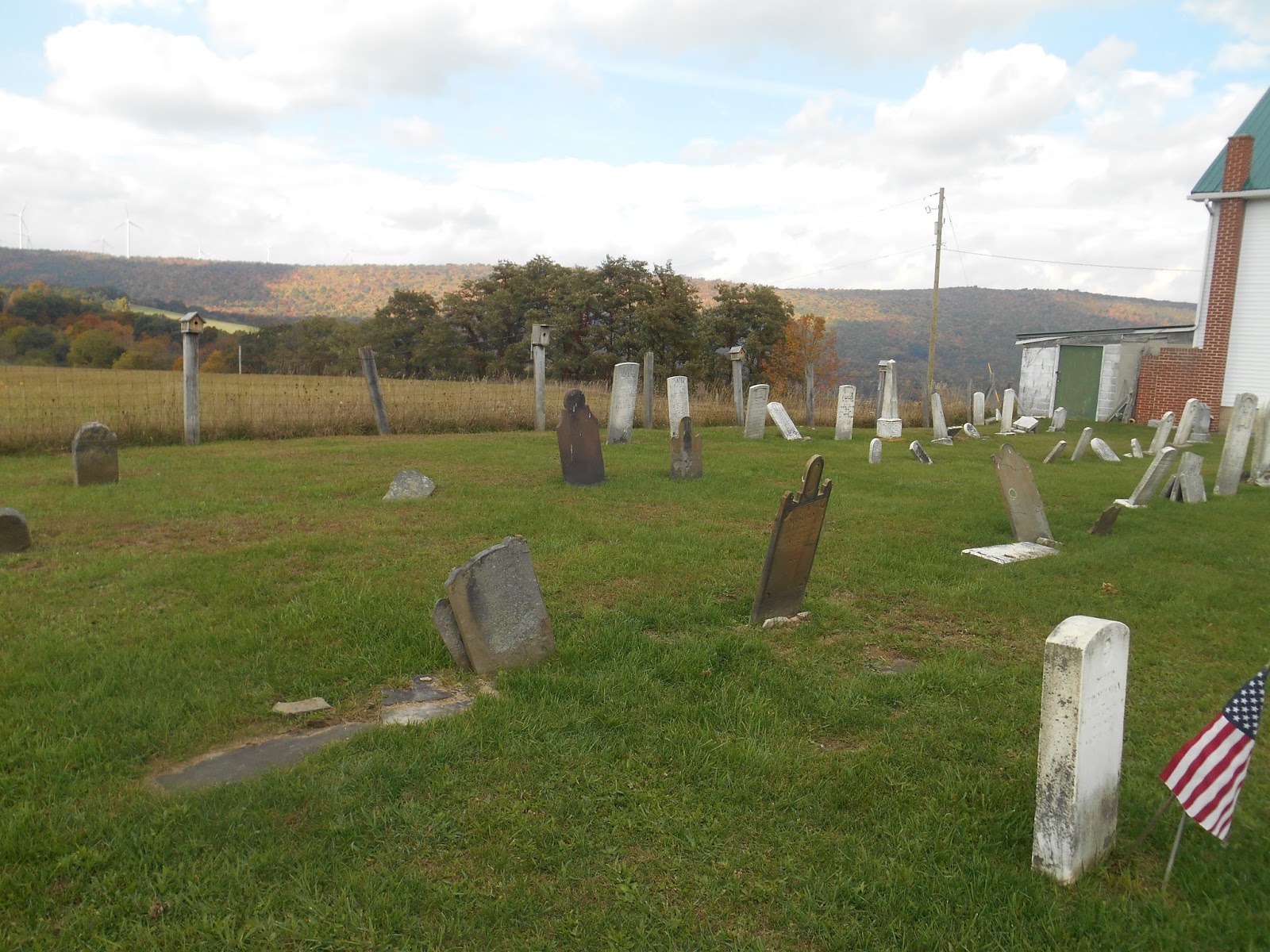
That's Peter's stone on the right foreground with the flag. His wife is marked by the brown stone, below, and in the above picture, to Peter's left and above.


That's Benjamin's stone standing tall above and his wife's stone, fallen, to the right.
You can see Peter's grave on the upper right of the image, with the flag.
 
The land is beautiful here and I just hope that I'll have the time to devote to finding some of those Troutman land records. Just discovered one in Berks that is a deed between William, mentioned as Peter's father, and Peter, separately mentioned as the son of William, and living in Bedford County.

Was talking to Mom when I was back to see her recently and we agreed that there's something about standing on the very soil of the ancestors that is extremely moving. I stood there at the edge of the Comps Church parking lot and I looked at a lovely farm off a ways. Yup, that was sure to have been Benjamin's land.


The URL for this post is:


Thursday, October 15, 2015

A visit to Comps Church and Cemetery and the Troutmans


One of the reasons that I've ignored this blog is that I post stuff to Facebook instead. Of course, they are two different vehicles. And I've really got to break the habit of just posting to Facebook because some of my cousins aren't on Facebook! So here we go on the Great Troutman Adventure of 2015!

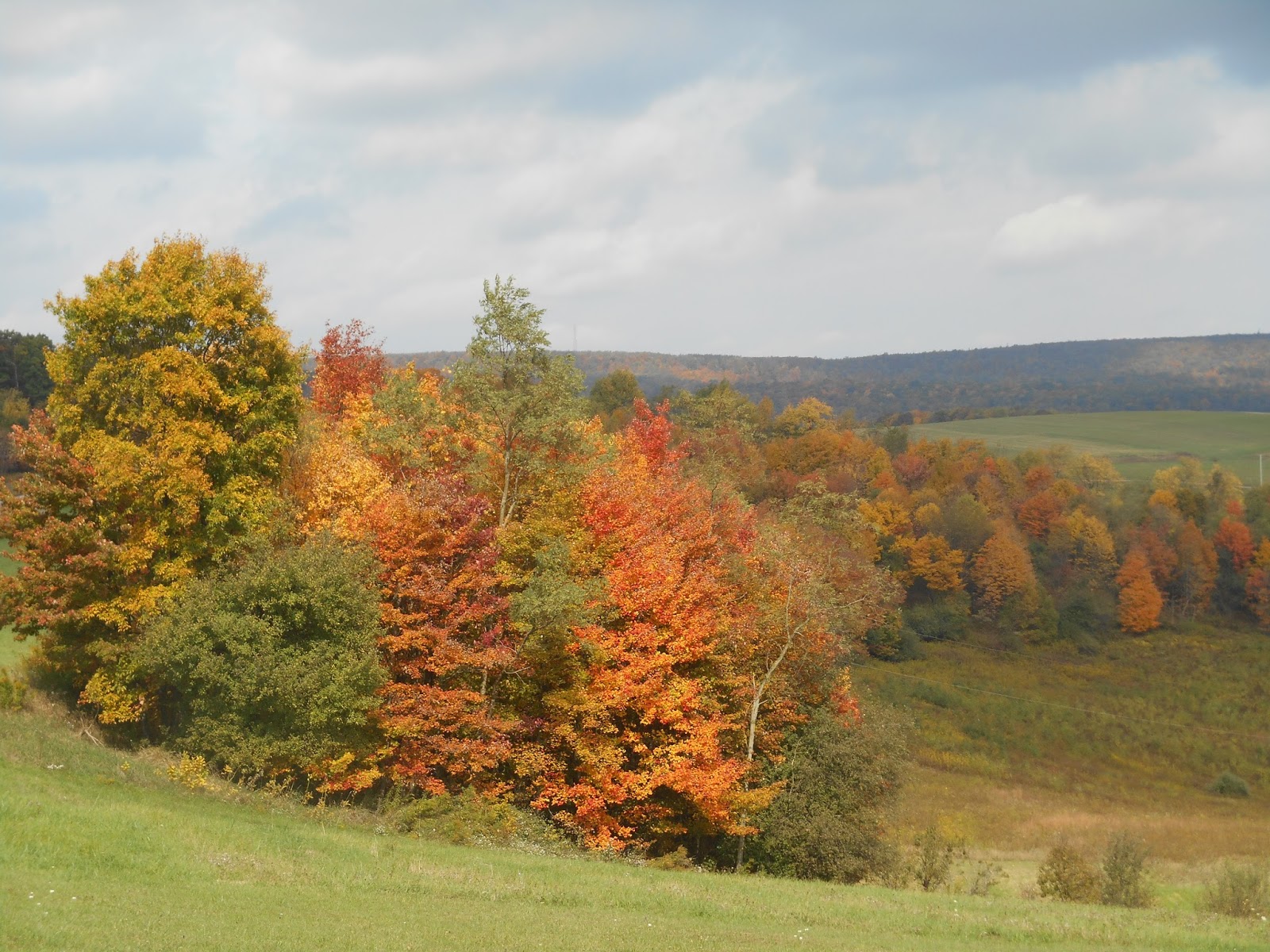
It was a nice warm day there in Western Maryland near the old Mason Dixon Line. Sunny, after a night of rain and the trees turning to fall colors. Mom and I were off for an adventure after breakfast at the Princess Restaurant on Main Street in Frostburg. We sat in the Truman booth where President Truman had lunch years ago. We do love that booth! Then we were off for a genealogy adventure, the kind that we are both lucky to get, Mom being 97 and both of us DAR members. We were going to see the graves of one of my DAR Patriots!!

Our goal was to find Comps Church, about 12 miles from Mom's house, as the crow flies. But us not being crows, it took some driving and chatting with the locals to figure out. Fifty miles later, we arrived. 

Maybe you've done this? Maybe you've set out on your genea-adventure with maps and plans and things written down? Along the way at some point you come to the shocking realization that you're missing some of the pieces. Ever done that? We just did!

What was missing? I thought Mom remembered how to get to Comps Church! After about 45 minutes of driving all around and up and down and stopping at some really picturesque country churches with no one home on a Friday afternoon, I slowly realized that Mom didn't remember, and was a bit shy about saying so. At 97, she is sharp as ever but the memory has it's moments, which is probably true of me too;)

Here's an example. We kept on driving past this road called Terra Alta. We're in Southampton Township, in Somerset County, PA in case you want to know, or maybe you have ancestors there...? So we drove past Terra Alta Road a couple of times. On the first pass Mom says, oh that's a pretty name. And on the second pass I chime in with, doesn't that sound familiar? On the third pass she said, why yes it does. So that time we stopped where a local man in overalls was selling cord wood for winter fires in wood burners. Did he by chance know where Comps Church was? Why yes he did. Turn right on Terra Alta Road. Oh. We had to laugh at ourselves!!!

I could have printed out a map, a couple of maps, a bushel of maps. Would have been the reasonable and safe thing to do. But noooo!! Silly me.

It was some miles more and about half-way to the turn on to Comps Church Road when we stopped to ask directions from a group of five men standing around a yard filled with cars in various states of repair. At first I hoped I hadn't made a mistake and stopped at the wrong sort of establishment. 


"Good morning gentlemen. We're trying to find Comps Church. We have people buried up there." They couldn't come over to help fast enough! They were awfully helpful. One even insisted that we follow him to the turn off. The grandfather was ready for a good long conversation with us, so I took an extra moment to talk with him. Have a very soft spot for the elders, even if their conversation rambles. Especially if their conversation rambles. We're looking for Troutman I told him. Oh, yes, they are still living all over these hills, he said. Well please tell them their cousin came to visit the old graves.


Comps Church and it's cemetery sit on a hill high above the rolling Allegany Mountains. That land over there, it was a bounty land grant given to my DAR ancestor, Peter Troutman. He's resting here in the Comps Church Cemetery, next to his brother, William Troutman, also a DAR patriot. They fought in the same company. Side by side. 


Peter had a rather long military history for a farmer and militia man. He ended up serving four tours of duty and one was as a substitute. His letter requesting a pension for his service outlines what he did and where and I'll have to write about that another time because it deserves a post of it's own.

Maybe you've been fortunate enough to read the pension file for one of your ancestors? If so, it's a thing to behold because it gives you a window into what it meant to serve in the Revolutionary War. Then with a little more effort you can find out what the battles were about, and who the commanding offices were. It helps to fill out the picture in a personal way.


I left stones atop their grave markers as is the custom. But this time I left a quarter too because I recently read about the military custom of leaving coins on stones and the meaning of each denomination. Wasn't there when he died, which is the true significance of the quarter, but because it is the highest honor so I dug for quarters. William, Peter's brother, got one too. 


Peter's son and my ancestor, Benjamin Franklin Troutman, is there too. I left a stone on his grave marker as well. And their wives are there, some listed with no maiden name, just X, and they received stones to honor their history.


I talked to them all a while. Some might think it silly but no one was around to cast a critical look.
Mom had been here years ago and taken pictures, long before I got interested in the ancestors and their stories. She sat in the car watching as I walked the rows and claimed the graves one more time.


The URL for this post is:

Tuesday, October 13, 2015

A trip to see Mom and a reminder about why I bolg


Just recently took a trip back east to see Mom, now 97, who lives in the tiny Western Maryland mountain  town of Frostburg. Mom's great, by the way and thanks for asking. We did a bunch of things "genealogy" and I'll get to all of that in later posts. But first, this.

Was sitting at breakfast with cousins Linda and JoAnn and we got to talking about the ancestors. I was playing around on Ancestry the night before because I realized that I didn't know much about their father, Uncle Harry. So I worked on his line for a while and discovered that he and his lovely wife and my own darling aunt Louise, Dad's sister, are 5th or 6th cousins! Had to do a proper Lol!

We were at the Princess Restaurant on Main Street, which is just as charming as you'd suspect and where they keeps the very booth President Truman and his wife Bess sat in on their way to the inauguration, and it's in perfect order and unchanged. After we ordered, I brought out two sheets of paper, one with Uncle Harry's lineage and the other with Aunt Louise's. And walked the cousins back to see how they connect at George Adam Eckhart, founder of the tiny town of Eckhart (now called Eckhart Mines, but that's another story).

They were amazed! Imagine being told out of the blue that your parents were cousins, if distant cousins. "Well, that explains a lot," one of them guffawed! I think all kids will at least half-believe that their parents are cousins!

One thing lead to another, we talked about a family mystery involving twins (we have a lot of them in the family, on both sides), and then, predictably, the graves. You see, we're a family that looks after graves and is pretty serious about it. I hadn't yet made it around to see Grandma and Grandpop Kelly's grave yet but had planned on it today. It's at St Michaels' Cemetery.

We knew Grandpop's own father was buried just down a couple of spots. Yes, we all knew that and that he's right there beside his wife Christiana Eckhart Kelly, and that's where the Kelly and Eckhart lines come together. What wasn't so well-known is that Grandpop Kelly's grandparents, John Kelly and Bridget Corcoran, who both came from Ireland, are buried in St. Mike's Cemetery as well.

I thought the table would explode! This was the second genea-hand grenade to hit the table! Where, they both questioned at once. I gave some general directions. Irish cross, to the left of the main entry lane that goes to the big cross in the middle, down a couple of rows.


We said our sad and heart-felt good-byes, and off we went. I swung down to the house to pick up Mom and some aluminum foil for a stone rubbing. Then we were off to visit that very memorial for John Kelly and Bridget.

Mom recalled how shocked with disbelief that Grandpop Kelly was when she told him that his own grandfather was buried in St Mike's. He too was a big tender of the graves and it was very important that his parents and all of them were looked after. So he practically couldn't come to terms with it to know that his own dear grandparents were buried there in the same cemetery with his parents... and he didn't know.

We went to see the nice Irish cross for old John Kelly who made his way from Shannonbridge Ireland to the mountains of Western Maryland, most likely to work on the railroad, as so many Irishmen of his day did. He found Bridget Corcoran and married in Cumberland and they raised eight fine children, the boys all strong and the girls beautiful, or so I imagine:)

Cousin Linda had left the Princess and beat a trail over to the cemetery to find Old John's gravestone. She even beat Mom and I there! By the time I'd texted her to say I was a couple of rows off, she texted back to say she'd already found it!!

At the end of our breakfast together one of the girls asked if I still keep up with this blog. No, I sheepishly said, been busy. Now I felt bad that I hadn't. What fabulous cousin bait this blog has been!! Ugh. Neglectful me.

So here I am back again. And I've got some wonderful new stories to tell, if I do say so my own self.


The URL for this post is:

Monday, April 27, 2015

Been busy

Well I haven't been here in a while!! True confession: just popped in to see if anyone is still finding this blog and whatta ya know, yes!

I've been very busy working on DAR prospective member applications. Just at the first of the year, I took the DAR online course and it was incredible. Oh, sure, there are other worthy courses out there but only the DAR GEP is slanted toward what needs to be done to prepare an application that will stand the test of scrutiny by the verifying genealogists at DAR HQ in Washington DC. The standards are high and you must submit a proof document for every fact you state on the application. Really, it's just genealogy the way it should be.

I've helped about a dozen or more ladies get their application ready, including my Mom. I'm sure the day will come when we'll get a Have Written or letter asking to prove something that was left unproven. But so far, so good! I've learned a lot about things and I'd like to share a few of them here.

The big lesson for me, and maybe you too, was that I need to slow the heck down and look into a document. I know that I rush things too much. Life is busy and on some days I don't feel as though I can slow down due to the pressure of a long To-Do list. Silly me! I found that out while taking the GEP course online. I'd think I was doing a thorough job of it but when it came to the quizzes the only ones I missed were when I rushed through and didn't pay the utmost attention. In the forums, it was a common complaint so I know that I'm not alone. The thing is that I now wonder how much really good stuff I've missed because I just wasn't paying attention! UGH! Always work to do, not only on the tree but on ourselves.

Speaking of trees, no one is "finished" with their tree. Quite often, when working with a prospective member, and after they've given me a link or invite to their tree online, they'll offer that "it's not done". Well of course! Never seen one that was! There's always more to find, and good stuff too, really fascinating stuff. And that, ladies and gentlemen of the jury, is why we are addicted to doing it! No surprise there. So maybe we all should stop feeling guilty and get over feeling like our trees should be "done", and just go get a cuppa and enjoy the process. It will never be DONE. And good for that thought!

Here's a tip: look in old books online. The last three applications I've worked on got to generation 7, usually the child of the patriot ancestor who fought in the Revolutionary War, and because vital records are few and far between, it's all but impossible to connect them to their parents. So there I am temptingly close to proving her direct line all the way from her back to her patriot ancestor, but missing one connection! I can't tell you how frustrating that is! What I learned from a DAR friend is that the best place to look is in old books documenting the history of a town or family.

When I first ran into this I looked on it with skepticism. I'd heard about the so-called vanity books of old written to prove some person's connection to a royal or famous ancestor and had been taught to be very skeptical of those. And I am. But as they say, don't throw the baby out with the bathwater! Look for books published in the later part of the 1800s, and look for those that have a narrow focus such as a town history. Then judge them based on the number of years between the death of the person being written about and the document being written. Is it likely that the subject and the writer knew each other? And lastly, how detailed is the story?

As an example, here a passage from one of the books found online in its entirety. You can see the detail in every sentence. This is from "The History of Edgar County, Illinois, etc." published in 1879.

Rev. William J. Mayo, the father of Col. Mayo, came here in the fall of 1825. He arrived on the 30th of November; the fall had been one of almost unprecedented loveliness, without a drop of rain for weeks, but on that night it set in to rain and continued a day or two. He located near the line between Hunter and Stratton Townships, where he died August 1, 1849, lacking but a few days of being eighty years of age. He had eaten his dinner, shaved himself, chopped some fire-wood at his woodpile, walked to the house, and was scraping his feet at the door, when he dropped dead. Col. Mayo and Mrs. Driskell, wife of Joseph Driskell, are the only survivors of twelve children. Mr. Mayo was a local preacher of the M. E. Church. Joseph Driskell, a son-in-law of his, is from Kentucky, and settled here in 1829, but is living at present in the city of Paris. Rev. John W. McReynolds was from Allen County, Ky., and came here in 1822. He was a brother-in-law of Col. Mayo--having married a sister of Mrs. Mayo.

See what I mean about detail?!


The URL for this post is: http://nutsfromthefamilytree.blogspot.com/2015/04/been-busy.html

Friday, January 30, 2015

I'm "stealing" this. But I just have to share it!!


I get Randy Seaver's excellent blog Genea-Musings by subscription in my morning email. The other day he posted about a hilarious cartoon that comes out three times a week all about genealogy. It's called Geneapalooza and is by genius guy, Esto Frigus. Check it out here.

So here's the thing. There's no link offered or info on how to contact Esto Frigus so I can't contact him to get his permission to share one of his cartoons, so I'm just going ahead and violating copyright and "stealing" it. Actually, I kinda doubt that Esto would pursue this "crime" through legal channels because I'm only saying very flattering stuff about him and his work:) It's super funny... if you're an avid genealogist! If you're the spouse, family or partner of an avid genealogist then maybe you'll not see it as quite so hilarious. Here's an example.


http://geneapalooza.blogspot.com/2014/08/blog-post_18.html
See more from Geneapalooza at http://geneapalooza.blogspot.com/

Thank you Esto, wherever you are!!  


The URL for this post is: http://nutsfromthefamilytree.blogspot.com/2015/01/im-stealing-this-but-i-just-have-to.html

Thursday, January 29, 2015

Couldn't you say that more directly?

OK, so this is probably old information and I'm the last girl on the block to "get it" but I have to make a confession: I've not been very good at those designations for evidence such as primary and secondary, direct and indirect, original or derivative. Just not thought about them much. But while taking the DAR Genealogy Education Program (GEP) course online, I finally understood and could see how designating a record or a piece of evidence on that record as one of those just listed would really help. When I'm digging for ancestors and  looking at some piece of paper or image on Ancestry or Family Search, I can know in a moment how helpful that item is going to be for me by using those designations. And if the document or info on it is not "good enough" then I know what I need to do to find better. And we want the very best when we look for records, don't we? Sure we do!

I get the difference between original and derivative. It has to do with whether the record is the original, in its original form, or some other version. An example is the Declaration of Independence. If you're looking at the original Declaration of Independence, unless you're in the National Archives in D.C. than you're probably looking at a copy, a derivative version. Is it a transcript that you're looking at? Did someone transcribe it and type it up? That's one example of a derivative version. It's legit alright, but it's not the original so it's derivative. Or maybe you're looking at a short write up version, a synopsis or abstract. That's another version and it's going to give you less information so maybe you'll miss the very bit you really wanted to see. Get it? If you had the original of the Declaration of Independence you'd have a national treasure. If you have an abstract, what do you have? A derivative version.

Same with the records we look at. Take wills for example. I love to look at original wills online. Love to see the handwriting, the X or signature telling me if the person who wrote the will could read or write. Transcripts are OK but they can be full of errors. And of course we can label them derivative. Will abstracts are the worst for me! You just know when you look at one it's leaving out the good stuff you want to know! Derivative.

Direct and indirect were terms that I have to admit I didn't really understand or see how they could be helpful. Let me elaborate on that. When someone explained them I understood for a little while but then in a few minutes I'd forget again because I couldn't see the helpfulness of the terms. Well, I get it now! If you ask someone how to get to First and Elm they can tell you, go straight two blocks, then left for five more blocks and you'll be at First and Elm, that's pretty direct information, don't you think? And if you asked another guy how to get to the same place and he rattled on and on describing landmarks and building that were there 40 years ago, maybe you could figure out how to get there, but maybe you couldn't. That's indirect information. Yuck. Give us direct information, please!

Indirect evidence leads you to a conclusion only by stringing together a series of pieces of evidence. Why can't it be stated directly, we ask ourselves along the way? Because there's no direct evidence available, only indirect evidence. It's a puzzle that needs to be put together... by you.

That only leaves primary and secondary to be sorted out. This one is pretty easy and I thought I understood how to use the two terms. But then I dug into a simple death certificate and -- bam! -- a big light went off that showed me the very heart of the matter and why it's important to know and use this type of evidence analysis. Who was that informant and what did they really know anyhow? The date and place of death was a sure bet. It was most likely to be correct (and was primary evidence) because it was very close in time (primary) to the event. The informant had usually been witness to the death and so probably knew exactly when and where it happened. But what of the birth place? Or the subjects parents, or get ready, the subject's parents place of birth! See how that could go all wrong and lead to incorrect information?

So now I'm not too surprised when I think about my 4th GGF's death certificate and how the informant, his undoubtedly upset and grieving wife, mixed up his parents surnames. It showed me just how easy it was to get incorrect secondary info on a vital record. Wow!

Primary and secondary. (Think death certificate.)
Direct and indirect. (Think driving directions.)
Original or derivative. (Think Declaration of Independence.)

There are more complex ways to sort documents and evidence. Elizabeth Shown Mills has a good one here and there's more info on her method here.

Now wasn't that fun?


Samuel Albert House (1832 - 1917) and
Mary Elizabeth Farrell House (1835 - 1919)

His death certificate, the Informant his wife. Notice the surnames of his parents! They were mixed and his parents were Rebecca House and Isaac Biggerstaff. He did not take his fathers surname for a big reason. More on that later, of just search on Biggerstaff in the search box on the top, right.


The URL for this post is: